
Truth and Reconciliation
When I started Canopy Immigration Law, I knew that the firm had to have a larger philosophy than just being a vehicle for capitalism. Immigration law has never been just that for me. It's always such a great area of law for connecting with individuals, families, the people behind growing businesses, and all the hopes and dreams held by them all.
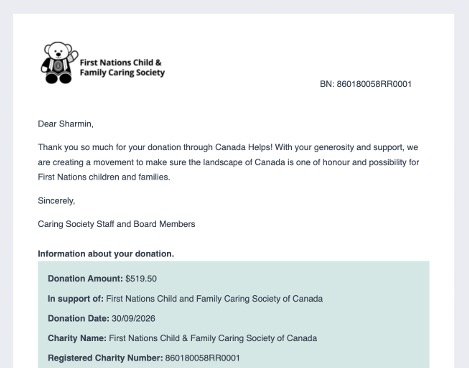
To that end, I made a pledge right on this website that as a Canadian immigrant driving further immigration to Canada, I would take seriously the responsibility to ally with the original inhabitants of Kanata and Tkarón:to, and that I would be dedicating a portion of firm proceeds in solidarity with these communities.
On National Day for Truth and Reconciliation, I made the first of what I hope will be many contributions to the work being done towards reconciliation. I know so many lawyers who take today to reflect, and I'm proud to be colleagues with all of you. I hope that more and more will use our privileges to support the (seemingly endless) work being done day in and day out to heal from the wounds of the past.

Ashes, a TIFF reflection
My husband and I had a rare date night yesterday at the Toronto International Film Festival to see Ashes, the newest movie from Diego Luna, which was recently picked up by Watermelon Pictures for wider distribution. The movie was incredible, and so well received in the audience. We were very lucky that Diego Luna, Anna Diaz (the lead actress), a producer, and a screenwriter were there to give us a Q&A after the movie.
The movie’s one that will hit home for every immigrant - and every immigration lawyer. It was high on my priority list for getting tickets to this year. It follows Lucila and the myriad of ways migration affects her childhood and life. From her mother leaving her at 14 to try and make a new life for herself in Spain, to her and her brother following them from Mexico years later, to her longing for “home” after experiencing tragedy, it’s a story that certainly every immigrant (and immigration lawyer) knows well.

Everybody to Kenmure Street
Over the weekend, my husband and I saw a beautiful documentary, Everybody to Kenmure Street, at a screening hosted by East End Acts. The film tracks a pivotal day in Glasgow in 2021. On the morning of Eid al-fitr, a dawn raid was carried out by UK Immigration Enforcement on Kenmure Street. What started as a handful of neighbours blocking the enforcement van from moving two Muslim men to immigration detention turned into 2,000 Glaswegians standing down the Scottish police who were protecting UK immigration enforcement, despite them having no legal mandate forcing them to.
I remember this story hitting my Twitter/X feed during Covid. I remember the visuals of this small sleepy suburban street that looked very similar to London’s Rodney Road, where I lived during my Master’s degree, being taken over by residents. I remember a Palestinian flag looming over the scene. And I remember the diversity that showed up that day (in age, race, gender, religion, and every other metric). This wasn’t just about the Muslim community coming together on Eid. It wasn’t just about a visible minority immigrant community coming together for humane immigration policies. It wasn’t even about activists coming together to oppose the government. It was neighbours protecting neighbours by saying “this isn’t right, and I’m not going to stand aside”. It was regular people getting ready for Eid prayers and grocery shopping and lunch with their grandparents who just decided to sit down in the street and not allow a van to move (along with one brave individual who got underneath the van!).

The PGP woes continue
On July 15, 2026, the federal government announced that they would be indefinitely pausing the Parents and Grandparents Program (PGP), a popular family sponsorship program. Promising to continue processing applications that have already been submitted, the government expects to approve up to 15,000 people for permanent residence both this year and next.
While these numbers may look impressive at first, it’s important to note that there are over 60,000 applications in process and that processing times are almost 3 years long. For an applicant-population that skews older due to the nature of the program, including the income requirements of sponsors in Canada, these processing times are extra burdensome.

The TFWP: Let’s not throw the baby out with the bathwater
A recent piece in The Walrus argued that the Temporary Foreign Worker Program (TFWP) is beyond hope, repair, or salvation and should be scrapped. With over 15 years of experience working with businesses of all stripes and in practically every industry, I can confidently say that the article is misguided, and, frankly speaking, a little lazy.
To say that a massive public policy should be scrapped is really only a fair comment if you have some idea of what the alternative could be, or if you can show that you've dealt with the minutiae of a program accessed by 20% of small businesses across Canada.
Canada is too big a country, with too small a population, and too diverse a set of already active industries and communities to look only inwards for sustainability. If those who want to see the TFWP completely dismantled, like Adnan Khan, are also arguing that some Canadian industries should be decimated and put out of business, that’s an entirely different conversation. It’s a conversation worth having, but let’s have it honestly.